Sunday, December 5, 2010

The Mandalore Connection


'Some said he was a Mandalore warrior; others said he merely wore the Mandalore battlesuit because of its unrivalled killing power. The truth was impossible to confirm, for none had seen the face that gazed with merciless eyes from within that battered helmet - none, at least, that lived to tell the tale.'
John Wagner, Boba Fett: When The Fat Lady Swings (1996)

'Not much is known about Boba Fett. He wears part of the uniform of the Imperial Shocktroopers, warriors from the olden time. Shocktroopers came from the far side of the galaxy and there aren't many of them left. They were wiped out by the Jedi Knights during the Clone Wars. Whether he was a shocktrooper or not is unknown. He is the best bounty hunter in the galaxy, and cares little for whom he works -- as long as they pay.'
Bantha Tracks #5 (Summer 1979)

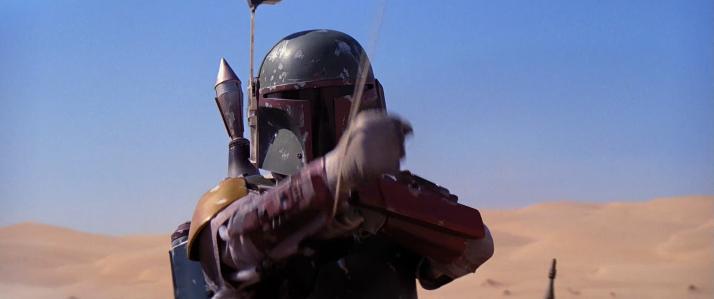
The in-universe origins of Boba Fett's wardrobe have been long debated, as much as, if not more so than any other aspect of the character. Every variation of the suit, even the original Holiday Special animation cells, carries with it some new questions about the history of the enigmatic bounty hunter - usually, "What is that, and where did it come from?" The Empire Strikes Back Sketchbook first confirmed Boba's helmet and armour as once belonging to a race of mysterious warriors called the Mandalorians, an ancient nemesis of the Jedi Knights.

Throughout early Star Wars EU literature it was left somewhat ambiguous as to whether Boba Fett was an actual Mandalore warrior or just an extremely proficient bounty hunter - many stories even contradicted each other. For instance, the Marvel comics render Boba Fett as a Mandalorian supercommando alongside Fenn Shysa and Tobbi Dala, who put honour aside and became a bounty hunter for the Empire; whereas The Last Man Standing: The Tale of Boba Fett by Daniel Keys Moran paints Boba Fett as a failed lawman who had nothing to do with the Mandalorians.

In this splash panel from 1983, white-cheeked Boba Fetts frenziedly shoot in all directions upon being shown a polaroid of Carrie Fisher.
This all changed with 2002's Attack of the Clones, which revealed Boba's 'father', Jango Fett, wearing what appeared to be a brand new set of Mandalorian armour. While it was never actually made explicit that Jango was one of the shocktroopers wiped out by the Jedi, the Expanded Universe took the assumption that Jango (and by extension, Boba) was the last of the Mandalorians and ran with it. Our first good look at the Mandalorians as a people came with 2002's Knight of the Old Republic, in which ancient warriors sparked the celebrated cultural pasttime of losing wars to the Jedi. This soon led to author Karen Traviss' take on the Mandalorians as a highly individualized and nomadic group.
Traviss began exploring the Mandalorians in her Republic Commando novels and later her installments of the Legacy of the Force series. She went so far as to develop an entire language around the characters. Her portrayal was readily adopted by fans, affectionately (or perhaps not so affectionately) referred to as Fandalorians. The Traviss Mandalorians were best described as a motley crew of Viking mercenary badasses who all looked and acted differently (though they all chewed on space jerky and suffered from Mary Sue complexes): basically an army of Boba Fetts who could do no wrong. Predictably, everyone loved this.

But the heads at Lucasfilm were telling a different story. In 2010 an episode of the Clone Wars entitled The Mandalore Plot was aired. The Mandalore Plot rewrote the book on the Mandalorians, showing them not as an adoptive culture of fighters but rather a repressed and sterilized Cubist society struggling to preserve peace and maintain pacifism, mirroring the postwar uncertainty of 1930's Germany with an added Star Wars flair.

Instantly there was uproar. 'Fandalorians' pinned the radical change in characterization on the usual scapegoat: the cackling, plaid-adorned Mephistophiles that is George Lucas.

Pictured: George Lucas being told what Uj'alayi means.

Dave Filoni explains the logic behind the New Mandalorians:

'Were they a mercenary people? Yes, they absolutely [were]. Did they fight against the Jedi? Yes, they absolutely did. Is there a big battle where there is a cataclysm between them and the Jedi? Yes. Have we pushed that idea, that the cataclysm was so great that the surface of Mandalore was laid to waste? Absolutely, we did. Because to George, the Mandalorians, above all, dating back to The Empire Strikes Back, are supercommandos. They're a race of people that were a military. They can't be so vagabond as they've appeared in the EU. They can't be this group of people that are vastly different in personality and paint scheme, because if you do that they look too much [...] like a bunch of Boba Fetts. It robbed Boba Fett of his uniqueness. We needed a military, we needed an army. They have a very uniform look. They're trying to bring back the ancient Mandalorian ways of being the supercommando, and regain dominion for their mythology, their stories, with what you could call the EU is: that they are a warrior race, and, eventually, mercenaries.'
Dave Filoni, Clone Wars Supervising Director, Creating Mandalore (2010)

Finally, we get the real story behind these guys. As hard as those at LFL like Dave Filoni and Leland Chee have tried to smooth out the effects of the retcon on existing canon, the truth is that George's explanation of the Mandalorians gears with the story told in the films, and for all the naysaying is actually a far more daring, original, and intelligent portrayal of the Mandalorians than what the EU has presented. It gives the group an internal conflict beyond 'to be badass, or to be more badass'.

Another change that The Mandalore Plot brought was a return to the ambiguity of the Fett family's ties to the Mandalorians. In the first moments of the episode we are informed that Jango Fett was no Mandalorian, and the nature of his armour was a mystery.

'The idea that Jango Fett is not a Mandalorian, that's something that comes directly from George. I think when we first saw Jango in Attack of the Clones that a lot of us, myself included, we assumed, "Oh, he must be a Mandalorian. There he is in Mandalorian armour." So there is kind of this early assumption that Jango must be a Mandalorian, and that was interesting to see. But that was never stated in the film. It was never stated that he was Mandalorian. He's always just referred to as a bounty hunter.'
Dave Filoni, Clone Wars Supervising Director, Creating Mandalore (2010)

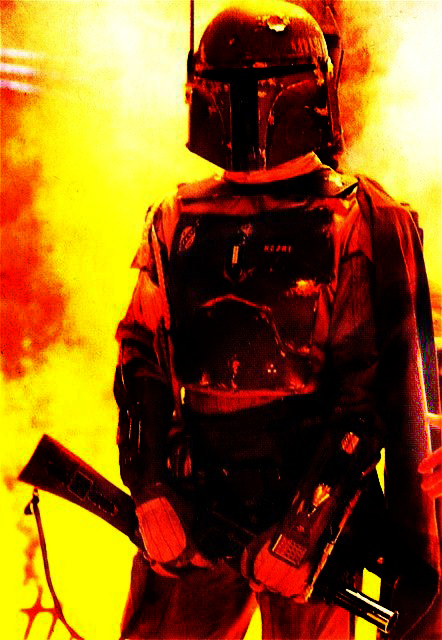
'Once you have that silver-blue, black and grey armour, of course, the first thing is, "Why is Boba's green? Where is that coming from?" And from the point that we've established in The Clone Wars from the point whenever Boba gets his armour, there's one thing that I think is important, [which] is that Mandalorian armour exists during the Clone Wars; Mandalorian armour that's very close to the design and use of Boba's armour. Boba has tricked his armour out. He's added a few things that our Death Watch guys don't have, because he's a bounty hunter. And much like a gunslinger in the old west who would shoot someone and take their hat or take their guns or...you know, you win a victory over another warrior and you take something of theirs. Boba Fett's armour is probably made up out of different pieces of Mandalorian gear. It's a little hodge-podge and mix and match, which I think lends itself to the idea that he acquires different pieces of Mandalorian armour over time. Why does he do that? Because his dad wore it. That's the connection for him. So I imagine, since Mandalorian armour really isn't being created again and again and again when you look at the time of the Empire, Boba, whenever he finds some of it, he fixes it up, he uses it. He's probably got a bunch of it in Slave 1. Different rocket packs, we've seen that on Boba. Different wrist guards, we've seen that on Boba. So how do our Death Watch go from being these silver pristine-looking uniformed military guys [to what Boba Fett's armour looks like?]...there must be something that happens between here and where Boba's getting all this weird green and yellow and red armour. We'll just have to wait and see.'
Dave Filoni, Clone Wars Supervising Director, Creating Mandalore (2010)

Indeed we will.  After three decades we finally have the official story on the Mandalore supercommandos - and like the best answers, it raises a whole new set of questions about Boba Fett and the Mandalore connection.
Oh, and Karen Traviss? She's writing books for Gears of War now.


Wednesday, December 1, 2010

What TheeeeeeeeAAAAARGH!? or How I Learned To Stop Worrying and Love The Sarlacc

'Here's my thing: When Return of the Jedi came out and Boba Fett fired off his rocket for the first time, it doesn't work right, first of all, which was heartbreaking to every little boy who had been waiting ten years for him to fire that f*cking rocket. And then he misfires it, gets bumped by a sight-impaired Han Solo and then falls, screaming like a woman, into the Sarlacc pit. And when that happened, every single boy was like, 'What the hell?!' And all I can think is: Boba Fett must have been feeling the exact same way. Nobody was cooler than Boba Fett and he was about to kill the Christ figure of the Jedi. He was about to kill his greatest enemy - and instead, in one fell swoop, when he was supposed to be the coolest ever, he got tripped into a hole that promises a thousand years of digestion. And that must have really sucked. Really sucked.'
Seth Green, 2008, dose.ca

'I mean, when I read the third one I mostly was upset with the cavalier attitude towards Boba Fett, who [had been] built up as this monumental bounty hunter, and he just sort of gets, y'know, he just flies away. I thought that was going to be a major revelation: off comes the helmet, "Oh my god, it's my mother, she's a double-agent for the good guys."'
Mark Hamill, 2004, Return of the Jedi DVD Commentary

If we're going to examine the Boba Fett character, it would be foolish not to get one topic of discussion out of the way right off the bat. Every Star Wars fan is familiar with the infamous skiff battle above the Pit of Carkoon that ended the first act of Return of the Jedi with a bang - as such, they are also familiar with the frenetic circumstances leading to Boba Fett's untimely and frankly bewildering on-screen demise. Many would agree that this is the most significant of the dents in the character's history, and while off-screen literature has detailed Fett's frequent and varied escapes from the maw of the Sarlacc, the numerous problems in this scene remain.
So, let's break it down:
    As Jabba's gang anticipates the execution of the star warriors,  glorified coaster-on-wheels R2-D2 rolls to the upper decks to spring Luke's plan. Pan to our bounty hunter's gaze, following the little droid: Fett knows something is up, as usual.
    
    
    Artoo delivers Luke's lightsaber at the last moment, and the executioners aboard the skiff are overwhelmed by a torrent of green lasers and John Williams orchestration. Costumed stuntmen and Wilhelm screams are everywhere. Lando joins Luke in the fray and nearly falls into the quickly growing pile-up of sweating extras.
    
    
    Cut to Boba Fett sprinting to the top deck and taking off like Richard Branson on a zipline across the Pacific. He lands on the skiff as Luke turns. Boba Fett menaces Corvette Summer with flare gun.


    (Note: This is where things start to get weird. Why did Fett just decide to engage a magic sword-wielding opponent in hand-to-hand combat when he could have stayed aboard the yacht and sent the skiff and all its passengers to kingdom come with a single rocket? Maybe this amounts to professional pride, thinking that it would be better to capture the last of the Jedi alive before...well, killing him anyway?)

    Just as expected, Luke swings his day-glo baseball bat and leaves Fett brandishing a sawed-off shotgun. We get a brief glimpse of Boba wobbling around like a giant parade float as Han and Chewie hit the deck.

    Hm.
    While Luke ponders why Harrison Ford's performance has reverted to Holiday Special-mode since coming out of carbon freeze, Boba whips out a futuristic and completely badass space lasso and hogties the Jedi like Jill McBain at the Sunday square dance.
    
     Boba was probably preparing to switch on that 'ole flamethrower of his and KFC those baby blues, but instead some dumbass Weequay bodyguard tries to steal the kill with a laser cannon. Luke deflects the shot back at Boba, who faceplants on the deck. This sequence is more humiliating than Charlie Brown missing that darn football every year.

    Sad.
    Luke, maybe feeling as uncomfortable as all the Boba Fett fans in this scenario, legs it over to the other skiff to go Seventh Voyage of Sinbad on some alien fools. Boba Fett wakes up, having just had a horrible dream about having his reputation go by way of the Hindenburg, and gets to his feet.


    Behind him Han Solo does the same, delivering a line that has haunted me for the majority of my sad little life:
    "Boba Fett?! Boba Fett?! Where?!"
    The money shot. Boba Fett reaches out like Doctor Manhattan, aims one of his thermonuclear rocket-propelled Widowmakers at hero of the saga, and...


    Fires some lasers. And misses.
    Run that by me again.

    (Note: What?! Fett had a missile primed and ready to derail the entire Star Wars franchise with one fell press of a button, but instead he fires lasers?! Lasers?! I wouldn't have a problem with him not getting to fire the rocket if they hadn't added that particular effect, but there it is! When given the chance, Boba makes the worst use of his arsenal imaginable. He might as well have thrown some rocks.)

    This is around the time where I burst into pathetic, squealing pig sobs. I'm not even going to go into the logic of Boba's jetpack activating so easily. You all know what happens. A blind smuggler swings an axe, a Jedi force-kicks some punk in the face, and a vagina dentata burps. The rest is, as they say, history, and requires no commentary.


    Yes. I know. I know Boba Fett climbed out of the pit (I wouldn't have managed to get through elementary school without that life-affirming knowledge), I know that all the main characters had script immunity by this point. Despite all my problems with this scene, I can't imagine it going down any other way, any more than I can imagine a different ending to Macbeth or Moby Dick (another story that featured a wickedly ambiguous antihero sent tumbling to his doom, accidentally, at the hands of his mortal enemy).

    George Lucas mentioned in the 2004 DVD commentary for Return of the Jedi that he considered adding a shot of Fett crawling out of the Sarlacc - as much as I'd feel personally gratified by such an addition, the film doesn't need it, and I think by now I've just about made my peace. In many ways Boba Fett's startling and indefinite demise added to the lasting appeal of the character. His end may be disappointing, but you can't say it isn't memorable.

    'But that’s what is so lovely about the Star Wars films, there’s so much to talk about and argue about. If I’m at a convention, someone will say, “Mr. Bulloch, what do you think about the death of Boba Fett when he goes into the Sarlacc Pit? Could you tell us a little bit more about that?” I’ll say, “No, I’m deeply depressed that Boba Fett went into the Sarlacc Pit. But I will get out. I promise you.” And they say, “thank you very much, Mr. Bulloch, thank you.” I just made someone happy because now I’m going to get out of the pit. You say to someone, “I stay down in the pit as long as I want. There are bounty hunters falling down there every day of the week and I’ve now opened a bar. I’ve opened a Hooters."'
    Jeremy Bulloch, 2010, Vanity Fair Magazine